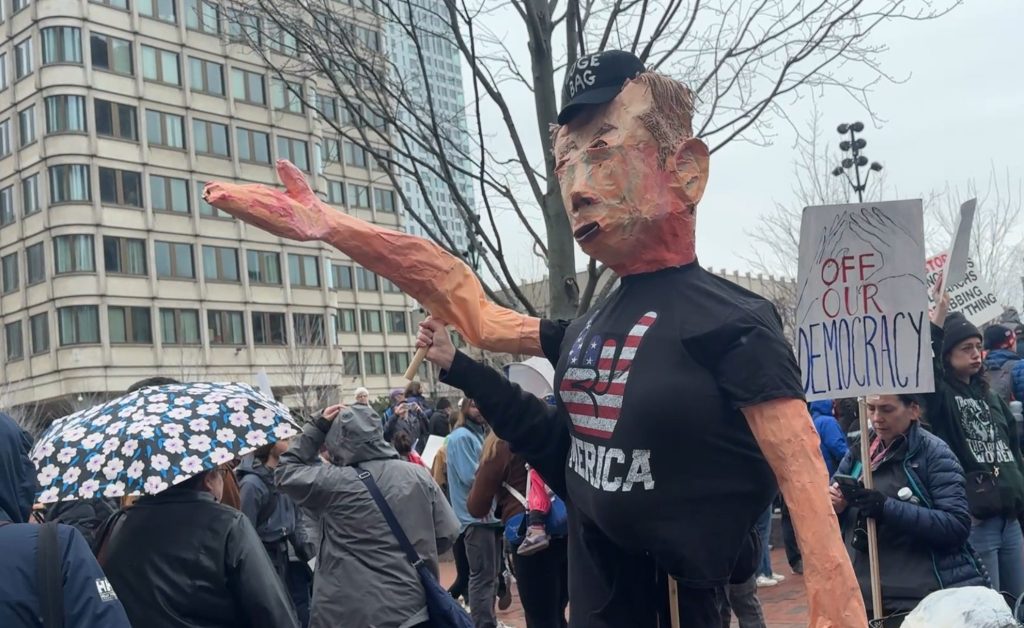
This post follows the Hands Off protest that took place in Boston Masschusettes on April 5th. An inside look into the purposes and rewards of protesting in public spaces and how people respond to injustice
Does Protesting Work?
By Fiona Averill
Tuesday, April 8
The TeslaTakedown movement, and the impact of boycotts today
As the political climate shifts rapidly, so too do the ways that we, as civilians, wield our power. The question of how citizens can practice effective activism is a prominent thought in many Americans’ heads, especially when all else seems hopeless.
The #TeslaTakedown movement has been a controversy in the news ever since President Trump made Elon Musk a prominent part of his White House staff. People who are angry about Elon’s presence have taken to the streets.
Elon Musk, who was previously known as a friend to the Democrats, started to become one of President Trump’s most prominent allies starting in 2023. Musk donated a very large amount of money to the Trump campaign, which is where talks of DOGE — the Department of Government Efficiency — started to arise. President Trump has now appointed Musk as the leader of this department.
The reason people are angry is because of two main factors. One, they are upset about the measures that DOGE has taken — for example, the major cuts being made to DEI(Diversity Equity and Inclusion) programs across universities in the country. And two, it is not evident that Musk has the legal grounds to be in this position of power. Musk is officially considered a “special government employee.” However, this position has not been approved by the Senate, creating controversy around his role.
Throughout the country over the last few weeks, people using the #TeslaTakedown tag have spread the word of protests. People have been gathering peacefully in front of Tesla stores in hopes of slowing down business for Musk. One protester, who only identified themself as Eric, said, “Our goal is to voice that this is not okay. We are the guardrails. We are the people. The only thing he understands is money, so we are hoping this gets through to him.”
Heather Jonston, the leader of the grassroots organization that has been protesting the Tesla store in the Back Bay of Boston, said their motive was: “To disrupt sales of Teslas peacefully. Not with property damage or anything like that, but we’re just standing in front of the store and saying like ‘Hey, if you buy a Tesla, you are financially backing Elon Musk, who is right now using his vast wealth to bankroll Republicans who are at fault to support Trump’s extremist agenda.’ So I think the economic impact of this is really powerful right now. A lot of Musk’s Tesla shares are collateral for loans, and the bank can force him to sell those if the value drops. Yeah, so we’re trying to drop the value. But another good part of this, even besides the economic action, is that we’re just like visible in the streets saying we’re not okay with what’s going on, and we hope that more people will join us.”
And more people did join them. On Saturday, April 5, the Tesla protesters, along with many other activist groups in Boston, gathered at the Boston Common for the “Hands Off March.” The protest reportedly had almost 100,000 Bostonians marching from the Boston Common, down Tremont Street to City Hall. There was an array of speakers, including Boston Mayor Michelle Wu and the band the Dropkick Murphys.
Although this protest was a “success” — the large turnout definitely sent a message to the government — the initial controversy of the validity of the Tesla movement continues.
When initial feelings of rage started to arise in concern to Musk being in the Oval Office, there were a few cases of vandalism on Tesla cars. There also was an overwhelming majority of older people at each of the Tesla-related demonstrations around Boston. Younger critics of the movement said there was no use protesting Elon Musk, their reasoning either being he was too rich to be touched or that his place in the White House is legitimate.
“The protesting of Tesla I find to be completely irrelevant. Posting a statement online or sharing conversations with people I feel has more of an impact than standing on the side of the street chanting,” said Sadie Stein, a second-year international finance major at the University of Northeastern.
Joe Worthy, the director of education at the Albert Einstein Institution — an organization that helps with peaceful protests — helps to shape how activism truly becomes effective: “By starting here (at the bottom of the pyramid depicted below), understanding your situation, you can develop a branch strategy. How and when are you going to engage, right? Like how many people do you need to recruit? And then you can engage in a more limited strategy. This is kind of like the stepping stones to get to your ultimate end.”

In such a digital world, it is all the harder to get people onto the streets. However, the impact that it makes is incomparable to other forms of resistance. Doubters who say smaller protesters are wasting their time fail to recognize that all movements have to start somewhere.
In this example in particular, it is evident that their cause grew. The grassroots leaders of the Back Bay #TeslaTakedown movement joined together with a plethora of other causes this past weekend at the “Hands Off” protest. Tesla stock has dropped 44% since January, according to CNN reporter Chris Idifore.
Although the political landscape is as rocky as ever, what remains true is the power of the people. The act of protest has been instrumental to the civil rights movement, the gay rights movement — even tracing back to the Revolutionary War. Protest is how change was made. The #TeslaTakedown movement, however small it started, has certainly made a dent in American history.
###################


 Fiona Averill
Leave a comment